
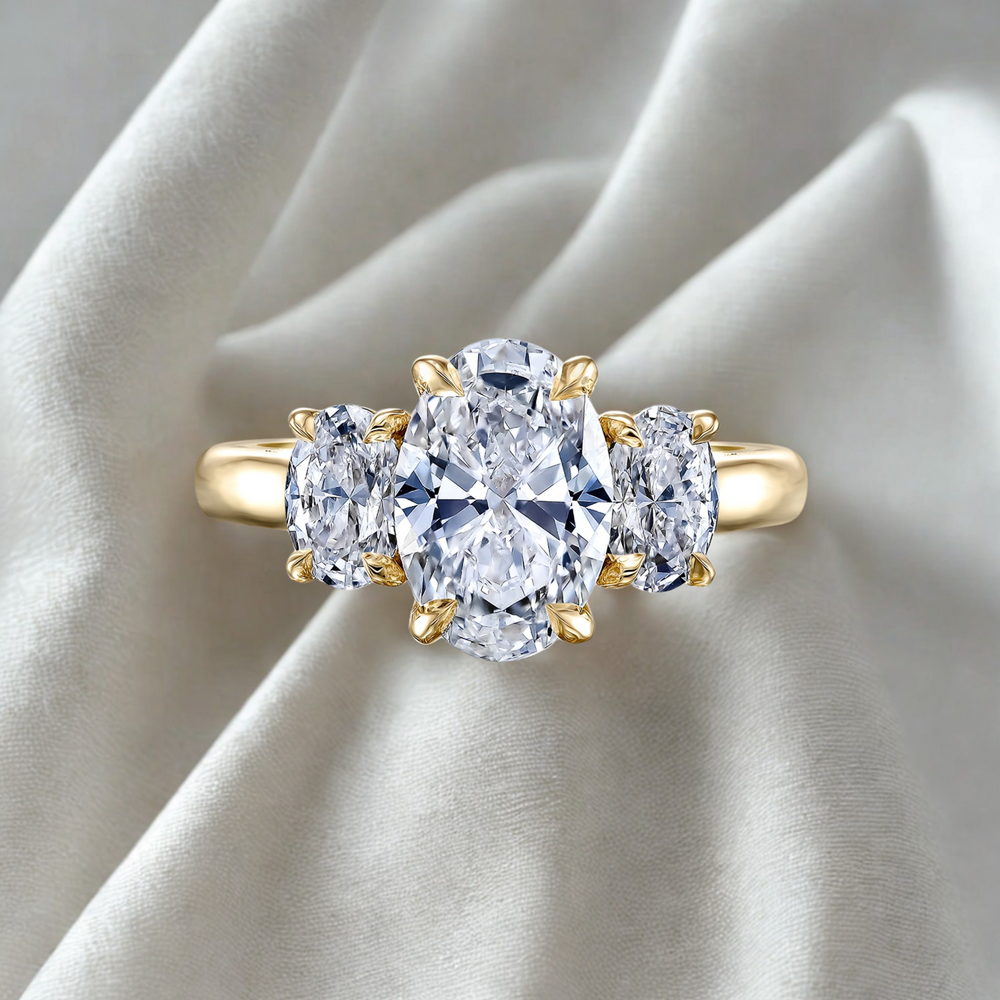
How To Buy A Loose Diamond?
Buying a loose diamond is easiest when you compare the stone in this order: cut and overall appearance first, then shape, carat size, color, clarity, and certification.
The goal is not to chase the highest grade in every category. It is to find the diamond that looks beautiful to you, performs well in real light, fits your budget, and works with the ring you plan to create.
At Simone & Son in Huntington Beach, we often help clients compare several diamonds side by side before any setting is chosen. That matters because two diamonds with similar grades can look surprisingly different in person.
A strong loose diamond should not only look good on paper. It should look right once it is on your hand.
Start With Cut, Not Carat
If sparkle matters to you, cut should be one of your first priorities.
Cut controls how efficiently a diamond returns light. A well-cut diamond can look lively and bright even if it is slightly smaller than another stone with more carat weight.
A poorly cut diamond may carry extra weight where you cannot see it, making the stone look smaller or darker from the top.
From The Jeweler’s Bench
When two diamonds are close in price, we usually prefer the one with stronger light performance over the one with a slightly higher carat number.
Choose The Shape Before You Fine-Tune The Grades
Shape changes almost everything: apparent size, sparkle style, setting options, and how the diamond looks on your hand.
Round Brilliant
Round diamonds usually give you the strongest classic brilliance and the easiest grading comparisons.
They are an excellent choice if sparkle is your first priority.
Oval, Pear, And Marquise
These elongated shapes can look larger for their carat weight because they cover more surface area across the finger.
They also require more visual inspection. Bow-tie effects, symmetry, and overall outline matter a great deal.
Emerald And Asscher
Step cuts create broad flashes rather than intense sparkle.
Because their facets are more open, clarity often becomes more noticeable.
Radiant And Cushion
These offer a balance between strong brilliance and a softer or more geometric outline.
They are especially versatile for custom engagement rings in Orange County.
Carat Weight Is Not The Same As Visual Size
Carat measures weight, not face-up dimensions.
Two 1.5-carat diamonds can look different in size if one is cut deeper and carries more weight below the surface.
That is why we look at:
-
Millimeter dimensions
-
Proportions
-
Shape
-
Cut quality
-
How much surface area you actually see
If you want more visible size, an elongated oval or pear may give you more finger coverage than a round diamond at the same weight.
Expert Tip
Do not ask only, “How many carats is it?” Ask, “How large does it actually look from the top?”
How Much Color Do You Really Need?
Diamond color is graded by how much body color is visible, but the best grade for you depends on shape, metal, and personal preference.
Higher color grades appear whiter, but you may not need to pay for the very top of the scale.
For example, a near-colorless diamond can still look beautifully white in many settings.
Yellow gold can also make slightly warmer diamonds feel very natural because the surrounding metal already introduces warmth.
Platinum and white gold create more contrast, so body color may be easier to notice.
|
Setting Direction |
What To Consider |
|
Platinum / White Gold |
Whiter diamonds may show more clearly |
|
Yellow Gold |
Slight warmth can blend naturally |
|
Rose Gold |
Warmth often feels intentional |
|
Halo With White Diamonds |
Center-stone color contrast becomes more visible |
This is where seeing the diamond inside the metal color you are considering can save you from paying for a grade you may not need.
How Much Clarity Is Enough?
Clarity describes internal and external characteristics in the diamond.
But the most important question is often simpler:
Can you see anything distracting with your eye?
If the diamond looks clean without magnification, moving to a much higher clarity grade may not improve its appearance in a meaningful way.
That is where budget can often be redirected toward:
-
Better cut
-
More carat weight
-
A preferred shape
-
A stronger custom setting
Step-cut diamonds such as emerald cuts usually deserve more careful clarity consideration because their large open facets can make inclusions easier to see.
Brilliant cuts often hide them better.
Always Compare Diamonds Side By Side
A grading report is important, but it cannot show you personality.
Put two diamonds next to each other.
Move them.
Look at them under bright light, softer light, and near a window if possible.
Notice:
-
Which one stays brighter
-
Which one has better contrast
-
Which outline you prefer
-
Whether inclusions are visible
-
Whether one feels more lively
-
Which one you keep looking back at
This is where preferences usually become clear.
Design Insight
The diamond you choose should still look compelling when the jewelry-case lighting is no longer doing the work for it.
What Should A Diamond Certificate Tell You?
A respected grading report gives you an independent description of the diamond’s measurable characteristics.
It can include:
-
Carat weight
-
Color grade
-
Clarity grade
-
Cut grade, when applicable
-
Measurements
-
Proportions
-
Fluorescence
-
Plotting or comments about inclusions
At Simone & Son, GIA documentation is an important part of the evaluation process.
But a certificate is not a beauty score.
Two diamonds with similar grades can still have different proportions, patterns, and visual appeal.
Use the report to verify what the stone is.
Use your eyes to decide whether you actually love it.
Should You Buy The Diamond Before The Setting?
Usually, the diamond and setting should be considered together.
The center stone affects:
-
Prong style
-
Setting height
-
Band width
-
Halo proportions
-
Side-stone size
-
Overall balance
A large oval may need a different band proportion than a compact round diamond.
An emerald cut may look strongest in a clean, architectural setting. A cushion may suit something softer or more detailed.
If you are planning a custom engagement ring, choosing the diamond first gives our design team exact dimensions to work with in CAD.
That allows the ring to be designed around your stone instead of forcing your diamond into a standard setting.
Natural Or Lab-Grown Diamond?
Both can be purchased as loose diamonds, and both have the same basic diamond crystal structure.
The decision often comes down to what matters most to you personally: budget, size, rarity, or long-term preference.
Instead of treating one as universally better, compare what each option allows you to do within the same budget.
You may prefer a smaller natural diamond with specific characteristics, or a larger lab-grown diamond that gives you more flexibility in the design.
The important part is knowing exactly what you are buying and having the diamond properly documented.
What Should You Avoid When Buying A Loose Diamond?
A few mistakes come up repeatedly.
Buying Only By Carat Weight
A heavier stone is not automatically a better-looking stone.
Paying For Grades You Cannot See
Very high color or clarity may add cost without noticeably improving the diamond to your eye.
Ignoring Proportions
This is especially important with ovals, pears, cushions, radiants, and other fancy shapes.
Choosing The Setting Too Late
The diamond and ring should support one another.
Comparing Only On A Screen
Photos and videos are helpful, but they do not replace seeing how a diamond reacts in real light.
Our Perspective At Simone & Son
Buying a loose diamond should feel less like decoding a grading chart and more like narrowing down what actually matters to you.
We look at the technical details first because they protect you from making a poor decision.
Then we move past them.
Does the diamond have life? Does the shape feel right on your hand? Does it work with the ring you want to build? Are you paying for something you can appreciate, or just for a higher line on the certificate?
As a family-owned jeweler crafting pieces in Orange County, we think the best diamond decision happens when the stone and the final design are considered as one.
How To Choose The Right Loose Diamond
-
Start with cut and shape.
-
Compare actual dimensions, not only carat weight.
-
Choose color and clarity based on what you can see and the metal you plan to use.
-
Review the grading report, then look past it.
-
And always think about the finished ring.
At Simone & Son in Huntington Beach, you can compare loose diamonds side by side and then design the setting around the stone you choose.
10124 Adams Ave
Huntington Beach, CA 92646
(714) 964-4012
info@simoneandson.com
The best loose diamond is not necessarily the one with the highest grades.
It is the one that gives you the strongest combination of beauty, proportion, value, and design potential.


