What causes the bow-tie effect in oval diamonds?
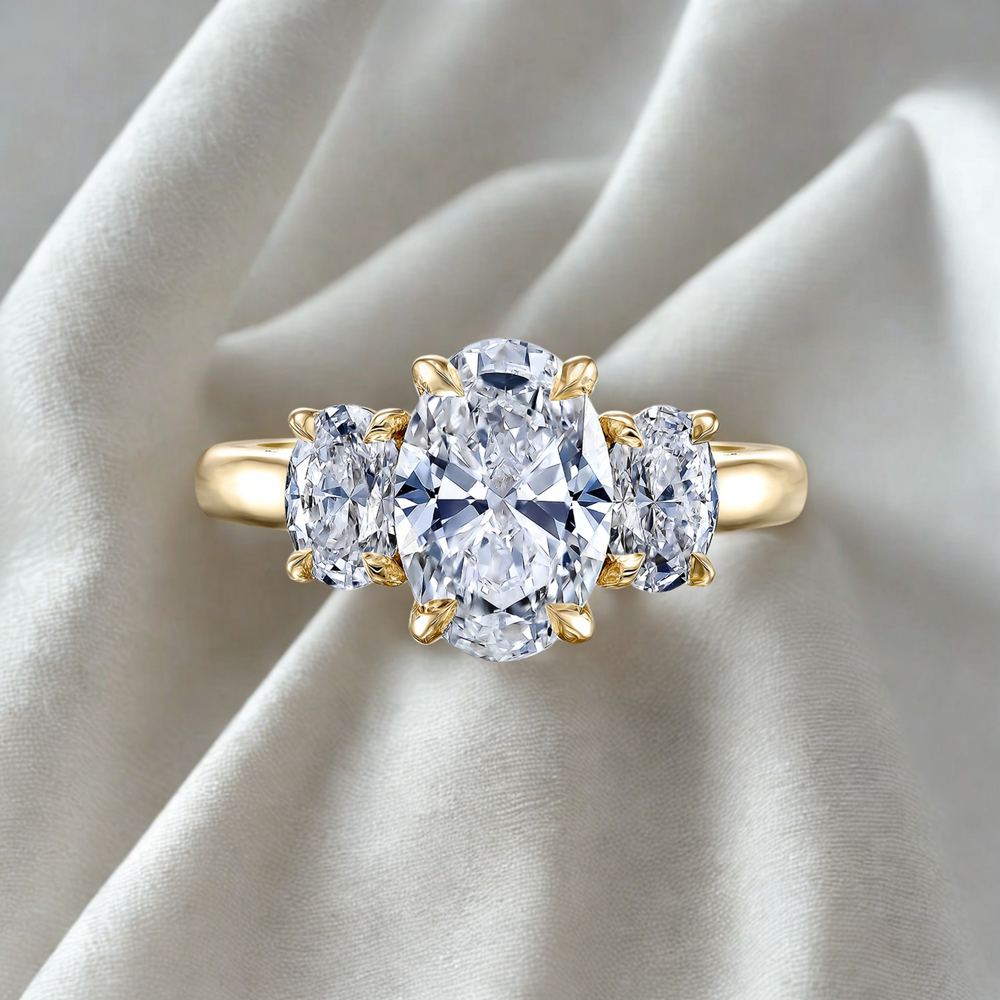
The bow-tie effect in an oval diamond is a darker area that appears across the center of the stone, usually resembling the shape of a bow tie. It happens because of the way an oval diamond’s elongated proportions and facet arrangement return light to your eye. Some contrast is normal in oval diamonds, but the strength of the effect can vary dramatically from one stone to another.
At Simone & Son, this is much easier to understand once two or three oval diamonds are placed beside each other.
One may stay lively through the middle as you move it.
Another may show a soft area of contrast.
A third may hold a noticeably dark band across the center.
That difference is what matters.
Why Do Oval Diamonds Have a Bow-Tie Effect?
An oval diamond is elongated rather than perfectly round.
That shape changes the way its facets gather and return light.
The facets inside the center of an oval can reflect darker areas from the environment around you, including your own silhouette as you look into the stone. Because of the oval’s geometry, that contrast can collect across the middle.
On the tray, it may look subtle at first.
Then we tilt the stone.
In one oval, the darker area breaks apart and bright flashes move through the center.
In another, the middle stays noticeably dark.
That is why we never judge an oval from one still position.
Is a Bow Tie in an Oval Diamond Bad?
Not necessarily.
A slight bow tie can give an oval diamond depth and contrast.
In fact, trying to eliminate every trace of contrast can become less useful than looking at how the entire diamond performs.
The issue is when the bow tie becomes the first thing you notice.
Imagine two ovals side by side.
One has bright ends, a lively center, and a little darker contrast that shifts as the diamond moves.
The other has a wide horizontal area that appears almost fixed and divides the stone visually.
Those are very different diamonds, even if their carat weight, color, and clarity are similar.
A Jeweler’s Read
We are not looking for an oval with absolutely no contrast.
We are looking for one whose center still feels alive.
What Makes One Oval Diamond’s Bow Tie Stronger?
The strength of the bow tie depends on how the diamond has been cut.
Several details work together:
-
The oval’s proportions
-
The relationship between its length and width
-
The angles of the facets
-
How light moves through the center
-
How the stone was shaped from the original rough
A more elongated oval can sometimes show stronger contrast, but there is no single ratio that guarantees a beautiful—or problematic—bow tie.
That is why two diamonds with very similar measurements can look completely different when we place them next to each other.
One may have a broad, graceful outline and even brightness.
Another may have an equally attractive shape but a darker center.
The numbers give us context.
The actual stone gives us the answer.
What Different Bow-Tie Effects Look Like
|
What You See |
Visual Effect |
How We Read It |
|
Very Soft Central Contrast |
Natural depth |
Usually not distracting |
|
Contrast That Brightens With Movement |
Lively and dimensional |
Often attractive |
|
Moderate, Balanced Bow Tie |
More defined personality |
Worth comparing in person |
|
Wide Dark Band |
Center feels divided |
More distracting |
|
Dark Area That Remains Fixed |
Reduced life through the middle |
Usually a reason to compare another oval |
The movement is important.
A photograph freezes one moment.
Your ring will not.
Every time you move your hand, reach for something, turn toward a window, or step outdoors, the diamond changes with the light.
That is the experience we care about.
Why We Move the Diamond Away From the Brightest Lights
Jewelry lighting is designed to make diamonds sparkle.
That is useful, but it is not the only way you will ever see your ring.
So we move the oval around.
We look at it under the counter lights.
Then we shift it away from them.
We look at it straight on.
Then from a slight angle.
Finally, we place it on your hand.
This is where a bow tie often becomes much easier to judge.
A stone that looked perfectly bright beneath intense lighting may reveal a heavier center in softer light.
Another stays beautifully balanced.
For someone choosing an oval engagement ring here in Huntington Beach or elsewhere in Orange County, this matters more than a perfect photograph.
You will live with the diamond in changing light.
How the Shape of the Oval Changes the Overall Look
Not every oval has the same silhouette.
Some are fuller and softer.
Others are longer and narrower.
That difference changes how the diamond looks on your finger, but it can also influence how you perceive the bow tie.
A long oval may feel elegant and lengthening.
A fuller oval may feel softer and more substantial.
Place both on the same hand and preferences often become clearer immediately.
Sometimes the elongated stone has the most beautiful overall shape but slightly more contrast.
Sometimes the fuller oval stays brighter through the center.
There is rarely one feature that makes the entire decision.
What Changes Once the Oval Is on Your Hand
This is where the diamond becomes more than a set of specifications.
One oval may have a faint bow tie but a silhouette you absolutely love.
Another may have beautifully even brightness but look too wide for your preference.
A third may have the balance you were looking for from the beginning.
We pay attention to what happens when you stop studying the diamond technically and simply look at your hand.
Do your eyes go to the shape?
The sparkle?
The length?
Or do they keep returning to that dark area in the middle?
If the bow tie is the first thing you notice every time, it is probably too strong for you.
If you have to search for it because everything else about the oval keeps taking over, that tells us something too.
How the Setting Changes the Way You See an Oval Diamond
At Simone & Son, the diamond and the setting are considered together.
A four-prong solitaire leaves the oval’s outline completely exposed.
A fine pavé band brings additional sparkle toward the center without changing its silhouette.
Tapered side stones can extend the diamond’s length visually.
A halo can make the overall center look broader and more substantial.
Because we create custom jewelry in-house in Orange County using CAD design, we can work around the proportions of the actual oval rather than designing around a generic shape.
This becomes especially useful when two beautiful diamonds have slightly different dimensions.
The setting can follow the diamond.
Our View at Simone & Son
When several oval diamonds are on the counter, we rarely choose one immediately.
We turn them.
Move them into softer light.
Put them on your hand.
Return to the first one.
Then compare again.
Often, the preference changes after that second look.
The bow-tie effect is simply one part of what gives an oval diamond its visual personality.
A little contrast can create depth.
A lively center can make the whole stone feel dynamic.
But when the dark area becomes the feature you notice before the shape, brilliance, or proportion, we usually keep comparing.
The strongest oval is not necessarily the one with the smallest bow tie.
It is the one where shape, movement, brightness, and contrast feel balanced together.
If you are comparing oval diamonds for an engagement ring, visit Simone & Son in Huntington Beach. We can place different ovals side by side, look at how each one responds to changing light, and design the setting around the diamond that feels right on your hand.
Simone & Son
10124 Adams Ave
Huntington Beach, CA 92646
(714) 964-4012
info@simoneandson.com


