
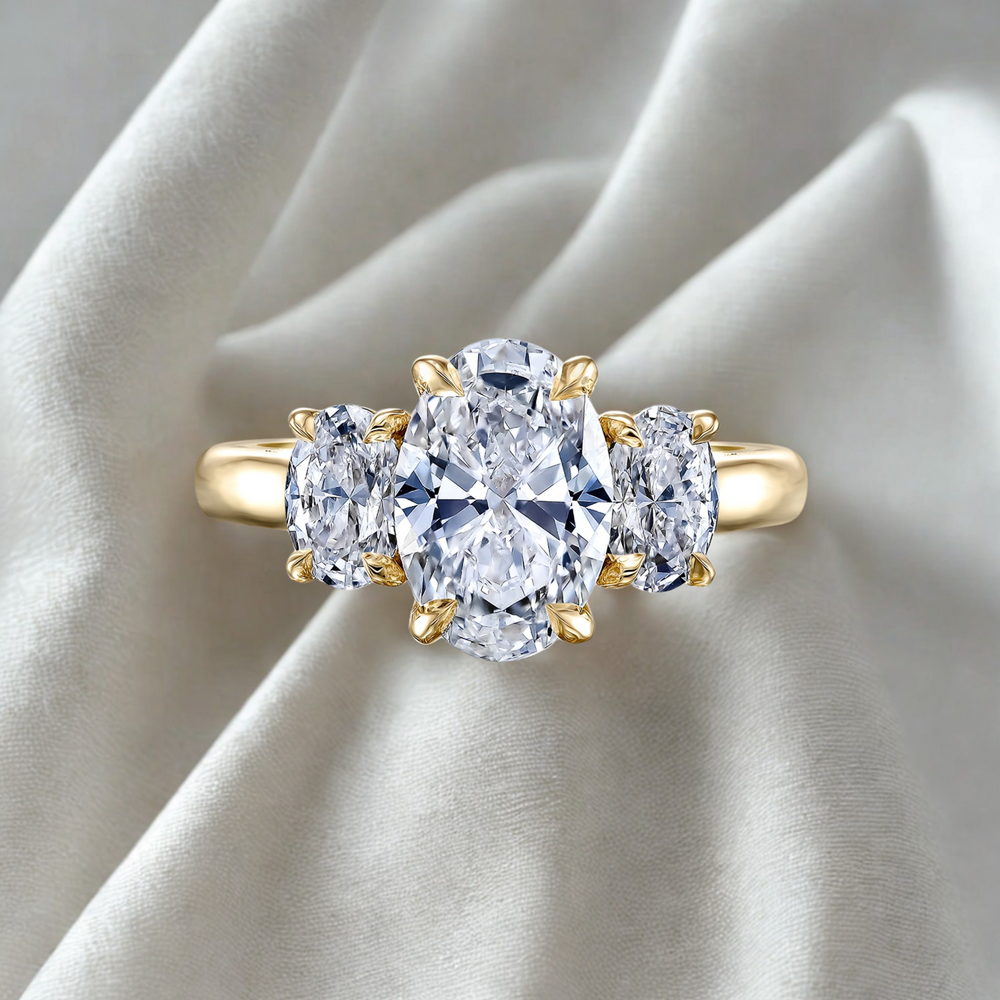
What are inclusions in diamonds?
Inclusions are natural internal characteristics that form within a diamond, and they are one of the main factors used to determine clarity. They may appear as tiny crystals, feathers, clouds, pinpoints, or other internal features. Most natural diamonds have some inclusions, and many are so small that you will never notice them without magnification.
For you as a buyer, the useful question is not simply whether inclusions are present. It is whether they affect the way the diamond looks, how it performs in light, or how comfortably we would recommend setting it. At Simone & Son in Orange County, that is where clarity becomes more practical than the grade printed on a report.
What Do Diamond Inclusions Look Like?
Inclusions can look very different from one diamond to another. Some appear as tiny transparent or dark crystals, while others resemble fine lines, small cloudy areas, or clusters of pinpoint-sized features.
Common examples include:
-
Crystals: Small minerals enclosed within the diamond
-
Feathers: Internal fractures that can appear white or feathery
-
Clouds: Groups of tiny pinpoints that may create a hazy area
-
Needles: Long, narrow crystal inclusions
-
Pinpoints: Very small internal dots
-
Cavities: Openings that may reach the diamond’s surface
The name alone does not tell you whether an inclusion should concern you. Its size, position, visibility, and relationship to the rest of the stone matter more.
Gem Fact
Two diamonds can receive the same clarity grade and still look noticeably different because their inclusions may be located in different places or have different visual effects.
Are Inclusions In Diamonds Bad?
Not necessarily. In many diamonds, inclusions have little or no visible effect once the stone is viewed normally.
This is why we do not recommend rejecting a diamond simply because its grading report lists several clarity characteristics. A small crystal near the edge may be far less noticeable than a similar inclusion directly beneath the center of the table.
Why We Pause At Certain Inclusions
There are moments when we do look more closely. If a feather reaches an exposed edge, if an inclusion sits near a vulnerable corner, or if a group of inclusions affects transparency, that can change our recommendation.
This is less about chasing microscopic perfection and more about understanding how the diamond will behave in the finished piece. A clarity characteristic that is harmless in one stone may deserve more attention in another.
What Does “Eye-Clean” Mean?
An eye-clean diamond is one whose inclusions are not readily visible without magnification during normal viewing.
That does not correspond to one single clarity grade. Some SI diamonds may appear eye-clean, while other stones with the same grade may show inclusions more easily depending on their size and location.
For many buyers, this is where value becomes more interesting. If a diamond looks clean to your eye, it may not make sense to pay significantly more simply to move into a higher clarity category that creates no visible improvement.
Expert Tip
Look at the diamond without magnification first. Then use a loupe or microscope to understand what is inside the stone rather than letting the magnified view become the entire decision.
How Do Inclusions Affect Diamond Clarity Grades?
Clarity grading considers the overall effect of a diamond’s internal and external characteristics, including their size, number, position, nature, and visibility.
|
Clarity Range |
General Description |
What It Usually Means For You |
|
FL / IF |
Flawless or internally flawless |
Extremely high clarity; very rare |
|
VVS1 / VVS2 |
Very, very slightly included |
Inclusions are very difficult to locate |
|
VS1 / VS2 |
Very slightly included |
Minor inclusions, often difficult to see without magnification |
|
SI1 / SI2 |
Slightly included |
Inclusions are easier to locate and may sometimes be visible |
|
I1 / I2 / I3 |
Included |
Inclusions may affect appearance or, in some cases, durability |
The scale is helpful, but it should be used as a filter rather than a final decision. Once two diamonds are in front of you, their actual appearance becomes more important than the letters alone.
Is A Higher Clarity Grade Always Worth More To You?
A higher clarity grade is technically rarer, but it is not always the most useful place to spend your budget.
Suppose a VS2 diamond and a VVS1 diamond both look equally clean without magnification. If the VS2 allows you to improve cut quality, reach the size you prefer, or put more into a custom setting, the lower clarity grade may give you a better overall result.
A Jeweler’s Read: When An Inclusion Actually Matters
When we compare diamonds, we do not give every inclusion equal importance. A tiny crystal positioned where you are unlikely to notice it can be far less significant than a feather near an exposed edge, even if both contribute to a similar clarity grade.
We also consider the diamond as a whole. If an inclusion is difficult to see without magnification, does not interrupt transparency or brilliance, and creates no concern for the intended setting, we may consider that stone a very strong choice. In some cases, accepting that unobtrusive inclusion can allow you to prioritize a better cut, a preferred size, or more of your budget toward the custom design.
The goal is not to find a diamond with nothing inside it. It is to understand which inclusions actually matter once the diamond is worn.
Can Inclusions Affect Sparkle?
Yes, but usually only when they are significant enough to interfere with transparency or light movement.
Small, isolated inclusions generally have little effect on brilliance. Larger clouds, extensive fractures, or dense groups of inclusions can make a diamond look less crisp or reduce the amount of light you perceive.
Cut quality should still remain a major priority. A well-cut diamond with a modest clarity grade can look much brighter than a higher-clarity stone with weaker proportions.
Design Insight
If the diamond will be set in a custom piece, the setting can sometimes help minimize a discreet edge inclusion while also protecting that area of the stone.
Can An Inclusion Make A Diamond Weaker?
Sometimes, but most inclusions do not create a practical durability concern.
Location matters. A significant feather near an exposed corner may deserve more attention than a small internal crystal positioned well inside the diamond. Shape also matters because pointed cuts, such as pear, marquise, and princess diamonds, have naturally more vulnerable tips or corners.
This is one reason we review the actual stone before finalizing a setting. The clarity grade tells us part of the story; the inclusion map and the finished design tell us the rest.
What Matters Most When You Compare Included Diamonds?
Once you understand the clarity grade, the next step is to connect it to what you can actually see and wear.
If an inclusion is unobtrusive, does not reduce transparency or brilliance, and creates no structural concern for the setting, it may have very little practical impact. In that situation, choosing a slightly lower clarity grade can be a smart way to preserve more of your budget for cut quality, carat weight, or a custom setting.
The opposite is also true. If the inclusion is easy to see, sits in a vulnerable position, or makes the diamond appear hazy, moving to a different stone may be the better choice.
So, What Are Inclusions In Diamonds?
Inclusions are natural internal features that help determine a diamond’s clarity, but they do not automatically make a diamond less beautiful or less suitable for jewelry. What matters most is where they are, how visible they are, and whether they affect appearance, light performance, or durability.
At Simone & Son in Huntington Beach, we look at clarity in the context of the complete piece. If you are choosing a diamond for a custom engagement ring or another meaningful design, we can help you compare stones side by side and understand which clarity differences actually matter for your decision.


